How to Create a High-Impact Trade Show Booth on a Budget

Trade shows give businesses an opportunity to introduce their products, connect with potential customers, generate leads, and build brand awareness. But with many exhibitors competing for attention, creating a booth that stands out can be challenging—especially when you are working with a limited marketing budget.
The good news is that an effective trade show booth does not have to be the biggest or most expensive one at the event. A thoughtful layout, consistent branding, clear messaging, and a welcoming visitor experience can help your business make a strong impression.
In this guide, we will explore practical ways to create an attractive and functional trade show booth while keeping your spending under control.
1. Set Clear Goals Before Designing Your Booth
Before purchasing displays or planning graphics, decide what you want your booth to achieve.
Your goal will influence the layout, messaging, promotional materials, and equipment you need.
Common trade show objectives include:
-
Generating qualified sales leads
-
Demonstrating products or services
-
Introducing a new product
-
Building brand awareness
-
Meeting existing customers and partners
-
Booking consultations or product demonstrations
For example, a business focused on lead generation may prioritize a simple consultation area and a clear call to action. A company demonstrating physical products may need more display space and room for visitors to interact with the products.
Choose one primary goal and two or three supporting objectives. This helps you spend your budget on elements that contribute to meaningful results rather than unnecessary decoration.
2. Plan Your Budget Around the Essentials
A trade show budget should include more than the booth display itself. Transportation, installation, promotional materials, and event fees can also affect your total spending.
Consider allocating your budget across these categories:
Display equipment: Backdrops, banner stands, tables, counters, and other physical display components.
Branding and graphics: Printed panels, logos, product images, and promotional messaging.
Transportation and storage: Shipping, carrying cases, packing materials, and storage between events.
Promotional materials: Brochures, samples, business cards, and QR codes that help visitors learn more.
Staffing and engagement: Staff preparation, product demonstrations, and any activities designed to attract visitors.
Contingency: A reserve for unexpected expenses, replacements, or last-minute event requirements.
Prioritize reusable display components that can work at multiple events. A modular display system may cost more initially than a one-time solution, but it can offer better value when used repeatedly.
3. Choose a Simple, Professional Booth Layout
An effective booth should be easy to understand at a glance. Visitors should be able to identify your business, understand what you offer, and see how to approach your team.
Start by dividing your space into three functional areas.
Brand visibility area
Place your main logo and primary message where they can be seen from the aisle. A backdrop or banner stand can establish a clear visual focal point.
Product or demonstration area
Arrange your products, samples, or demonstration equipment so visitors can examine them without blocking the entrance or crowding the booth.
Conversation area
Provide enough room for visitors to speak with your team. Depending on your space, this may be a simple counter, a small table, or an open standing area.
Avoid filling every available space with displays. A booth that feels open and organized can be more inviting than one crowded with promotional materials.
Before the event, check your assigned booth dimensions, height restrictions, electrical requirements, and any venue-specific display rules.
4. Invest in Branding That Is Easy to Recognize
Consistent branding can help visitors remember your business after the event.
Your booth should use the same logo, brand colors, and visual style found on your website and other marketing materials.
For a cohesive presentation, consider:
-
A prominent, correctly positioned logo
-
A limited color palette
-
High-quality product images
-
Short, readable headlines
-
Consistent fonts and graphic styles
-
A clear website address or QR code
Avoid placing too much text on your backdrop. Attendees often pass booths quickly, so your main message should be easy to understand in a few seconds.
Instead of listing every service you offer, highlight the primary benefit that matters most to your target audience.
For example, a business selling promotional products could use a concise message about helping brands create memorable event experiences.
5. Use Reusable Custom Trade Show Displays
Reusable displays can help businesses maintain a professional appearance across multiple exhibitions without redesigning the entire booth for every event.
Depending on your needs, useful options may include:
Tension fabric displays: These provide a smooth printed backdrop for brand messaging, product imagery, or campaign graphics.
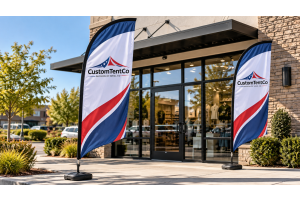
Banner stands: These can highlight specific products, promotions, or supporting information in a compact footprint.
Modular booth systems: These allow businesses to arrange display components for different booth sizes and event formats.
Branded counters: These provide a practical surface for demonstrations, brochures, product samples, and conversations.
Custom canopy tents: For outdoor exhibitions and promotional events, a branded canopy can create a recognizable event space. Explore CustomTentCo's custom canopy tents to consider options for outdoor marketing.
Select displays based on your available space, frequency of use, transportation requirements, and branding objectives.
6. Make Your Graphics Work Harder
Great booth graphics do more than make a display attractive. They help communicate what your business does and why a visitor should care.
Use this simple hierarchy when designing your graphics:
-
Business identity: Make your company name or logo easy to recognize.
-
Primary message: Explain your main offering or value proposition.
-
Supporting visual: Use a relevant product image, demonstration photo, or graphic.
-
Call to action: Tell visitors what to do next, such as scanning a QR code or speaking with your team.
Keep important text large enough to read from the expected viewing distance. Use strong contrast between text and background, and avoid placing essential information in areas that may be obscured by furniture or people.
Before approving the final artwork, check the spelling, logo proportions, colors, image resolution, and print dimensions. Ask your supplier for a proof or mockup so you can review the layout before production.
If you need help preparing artwork, review CustomTentCo's graphic design services.
7. Create an Inviting Visitor Experience
A visually attractive booth can draw attention, but the visitor experience helps turn that attention into useful business conversations.
Train your team to greet visitors naturally, ask relevant questions, and explain your offering without overwhelming people with a long sales pitch.
Here are several practical ideas:
-
Demonstrate a product or service when appropriate.
-
Offer a sample or a useful takeaway.
-
Use a QR code to direct visitors to a relevant landing page.
-
Prepare a short explanation of your main product benefits.
-
Make sure staff can answer common questions.
-
Provide a clear next step for interested prospects.
Avoid relying entirely on giveaways to attract visitors. A giveaway may generate foot traffic, but relevant conversations and qualified leads are usually more valuable than collecting a large number of unqualified contacts.
8. Use Lighting and Height Strategically
Your booth needs to remain visible in a busy exhibition environment.
If the venue permits it, appropriate lighting can help highlight products, printed graphics, and demonstration areas. Keep lighting comfortable for visitors and ensure that any electrical equipment complies with venue requirements.
You can also use vertical space strategically with backdrops, permitted hanging signage, or banner stands.
Before investing in overhead displays, confirm the event's height limits, hanging-sign policies, installation requirements, and additional fees.
The objective is not to make every part of your booth large. It is to make the most important parts easy to notice.
9. Prepare for Efficient Setup and Transport
A booth that looks impressive in a design mockup still needs to be practical in real life.
If your team attends several events each year, choose equipment that can be transported, assembled, dismantled, and stored efficiently.
Before the show:
-
Create a packing checklist.
-
Label components and accessories.
-
Keep assembly instructions with the equipment.
-
Inspect printed graphics and hardware.
-
Confirm delivery dates and loading procedures.
-
Allow time for setup and troubleshooting.
-
Check the booth before the exhibition opens.
A well-organized setup process can reduce stress and help your team focus on engaging visitors rather than solving avoidable logistical problems.
10. Measure Your Trade Show Results
Your booth should support measurable business outcomes. After the event, review what worked and where improvements are needed.
Track metrics such as:
-
Number of relevant visitor conversations
-
Qualified leads collected
-
Product demonstrations completed
-
Follow-up meetings booked
-
Sales opportunities generated
-
Cost per qualified lead
-
Revenue attributable to the event, when measurable
Compare these results with your original objectives. If visitors frequently passed without stopping, you may need a clearer headline or a more visible display. If you attracted interest but collected few leads, consider improving your call to action or follow-up process.
Use these insights to improve future booth designs and marketing activities.
Common Trade Show Booth Mistakes to Avoid
Even a well-funded booth can underperform when its design or visitor experience is poorly planned.
Avoid these common mistakes:
Too much text: Long paragraphs are difficult to read while walking through an exhibition.
Inconsistent branding: Different colors, fonts, and visual styles can make your booth feel disconnected from your other marketing.
Cluttered layout: Too many products, banners, and promotional items can make the space difficult to navigate.
Poor staff preparation: Visitors may leave without understanding your offering if staff cannot explain it clearly.
Ignoring event rules: Displays that exceed height limits or violate venue requirements can create last-minute problems.
No follow-up plan: Leads lose value when interested visitors do not receive timely, relevant follow-up after the event.
Frequently Asked Questions
What makes a trade show booth effective?
An effective trade show booth combines visible branding, a clear message, an organized layout, and useful interactions with visitors. It should make it easy for attendees to understand your business and take the next step.
How can a small business create an affordable trade show booth?
Start with a clear objective, invest in reusable display equipment, keep graphics simple, and prioritize the products or messages most relevant to your audience. Avoid spending money on accessories that do not support your goals.
Which displays are useful for a small trade show booth?
Banner stands, tension fabric backdrops, compact counters, and branded table covers can work well in smaller spaces. The right combination depends on your booth dimensions and whether you need to demonstrate products or conduct conversations.
Should I use the same booth for every event?
A reusable booth can save money and help maintain consistent branding. However, you may need to adjust the layout, messaging, or accessories to suit different audiences, event formats, and booth dimensions.
How do I measure trade show booth ROI?
Compare the total event cost with the value of the results generated, such as qualified leads, sales opportunities, and attributable revenue. Because some sales take time to close, establish a follow-up period before evaluating the final outcome.
Final Thoughts
Creating a high-impact trade show booth does not require an unlimited budget. It requires a clear goal, thoughtful design, consistent branding, and a practical plan for engaging visitors.
Start with the essentials, invest in reusable displays, keep your message simple, and make the visitor experience a priority. Then measure your results and use what you learn to improve future exhibitions.
Whether you are preparing for your first trade show or upgrading an existing setup, the right combination of displays and graphics can help your business present itself professionally.
Explore CustomTentCo for display solutions that can support your next trade show, exhibition, or promotional event.